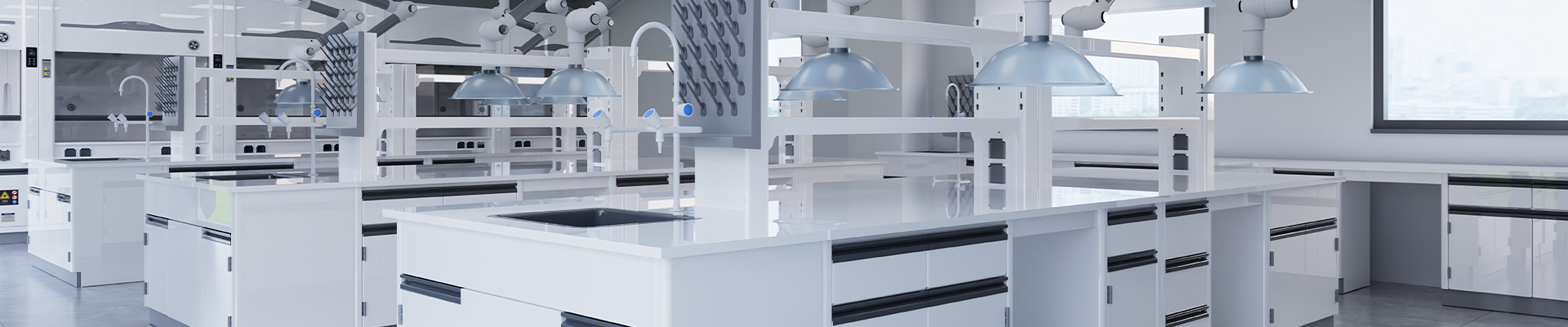
Jinhua Ritop Steel Cabinet Co., Ltd. exhibited at Thailand Lab 2026 in Bangkok, 2 to 4 September, at booth 2Q19. Four models stood on the stand: the P2 PP fume hood, the T6 steel fume hood, an industrial safety cabinet and the F6 all-steel lab bench, with both hoods running live so visitors could check face velocity at the sash.
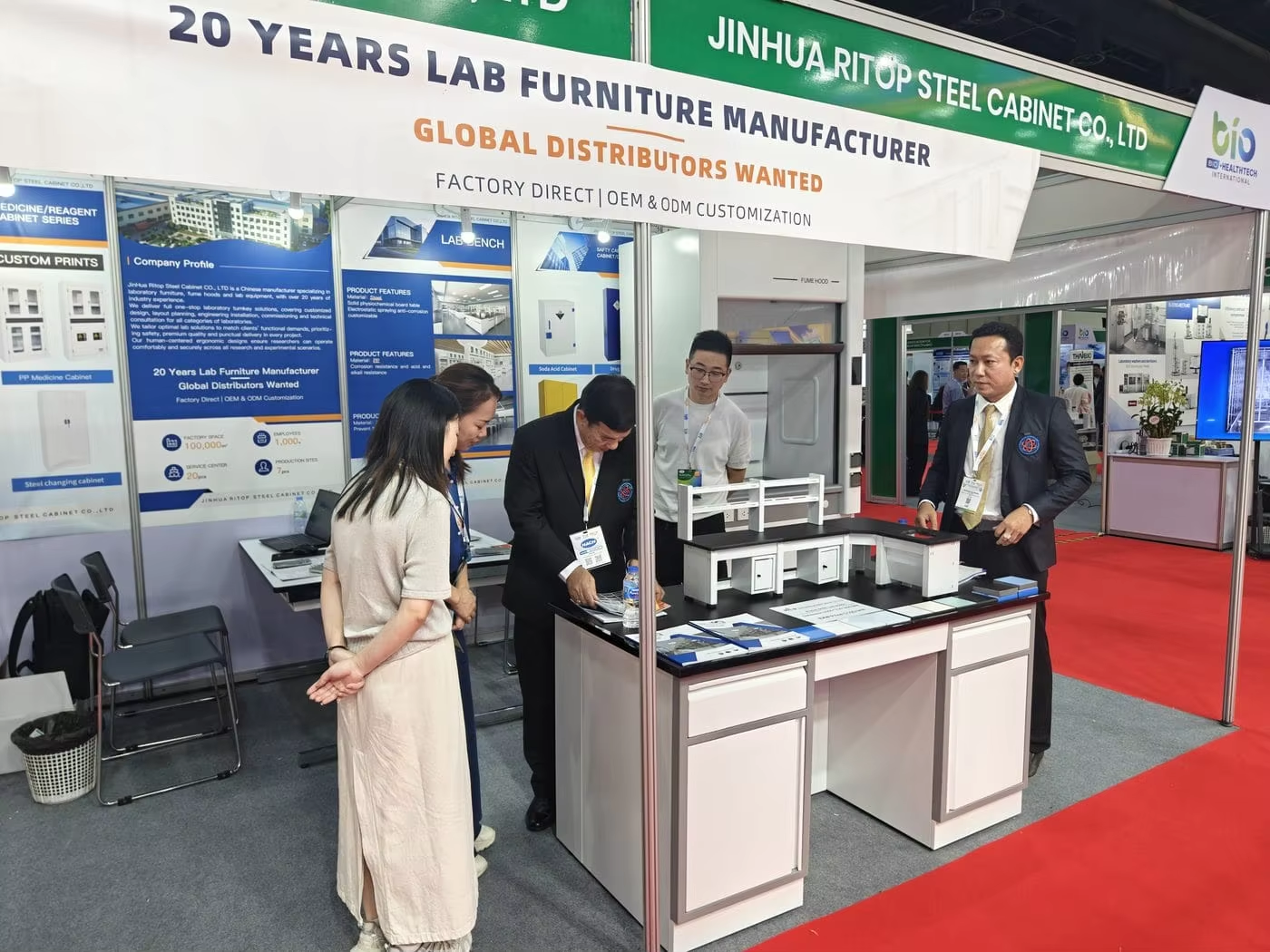
Booth 2Q19 at Thailand Lab 2026, Bangkok: the F6 all-steel lab bench and a bench-top fume hood model.
What Stood on Booth 2Q19
| Model |
What it is |
The problem it answers |
| P2 |
PP fume hood in 8-10 mm polypropylene |
Strong-acid work that destroys coated steel |
| T6 |
Steel fume hood with an integrated control panel |
Everyday chemistry, long shifts, low noise |
| Industrial safety cabinet |
Double-wall steel with flame arresters |
Flammable liquid storage next to the bench |
| F6 |
All-steel lab bench with a solid compact laminate top |
Benches that must be reconfigured without rebuilding |
Thailand Lab draws hospital and university laboratories, pharma and food testing labs, and the distributors who supply them. That mix shaped the stand: two fume hoods for two chemical loads, one storage cabinet, and a bench that survives a re-layout.
The P2 PP Fume Hood: for Acid That Eats Coatings
-
A polypropylene chamber welded into one shell. The working chamber is built from 8 to 10 mm polypropylene sheet, cut on CNC and welded so the inner wall has no joint for acid to creep behind. A PP fume hood gives up nothing to steel on airflow, and it removes the recoating cycle that hydrofluoric, nitric and hydrochloric acid service forces on a coated hood.
-
Face velocity held between 0.3 and 0.5 m/s. A streamlined collection chamber behind the baffle keeps the airflow even across the opening instead of pulling a fast column up the center. The design follows the ASHRAE 110 containment approach, and visitors at the show watched the reading at the sash rather than a datasheet.
-
Control that watches the sash as well as the airflow. The touch controller monitors both, alarms when the sash passes its working height or the airflow drifts, and can be ordered with a variable-air-volume mode that follows sash position. Our own comparison puts that at roughly 30% less energy than a constant-volume fume hood.
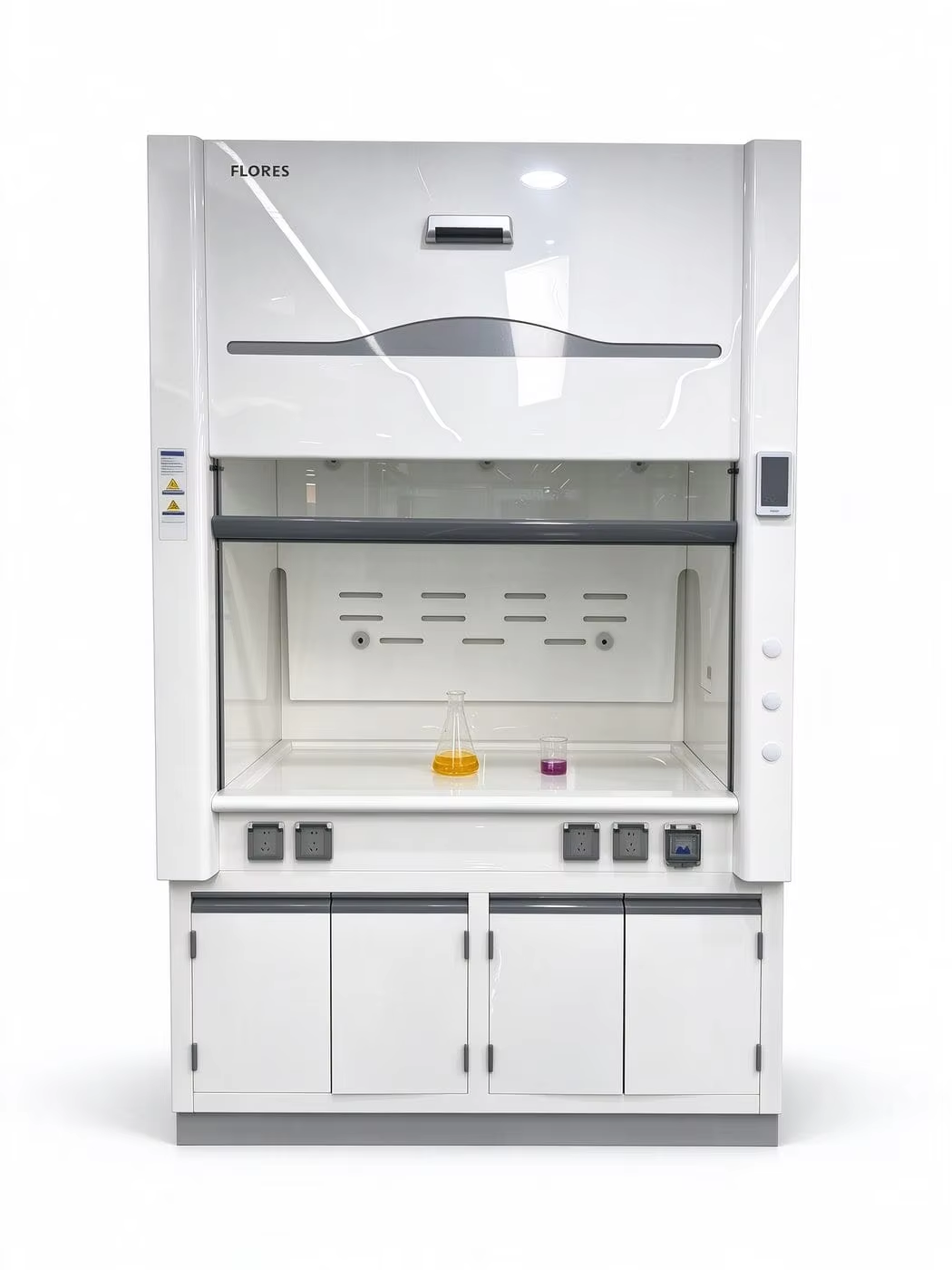
The P2 PP fume hood: an 8-10 mm polypropylene chamber welded into one shell.
The PP range, the steel models and the ductless units are listed together under Lab Fume Hood.
The T6 Steel Fume Hood: the Workhorse of the Stand
Where the P2 takes the strong acids, the T6 takes everything else, and most projects need both.
-
Airflow built for stability. The cabinet and baffle geometry are set to hold a steady face velocity across the working opening, which is what keeps vapor inside the chamber instead of rolling out over the sash.
-
One panel for the whole hood. The control panel groups the fan, the lighting, the airflow setting and the valve control, so an operator runs the hood from one place instead of reaching around the chamber.
-
A body that resists fire and chemistry. The outer shell is cold-rolled steel with an epoxy coating; the liner and the worktop are chosen for acid, alkali and heat resistance.
-
Quiet, low-draw operation. The duct path and fan matching are set for long shifts in a room where people also sit and write, so noise and energy draw stay down.
-
Modular safety options. Sockets, gas cocks, a cup sink and lighting come as standard, with a safety shower, an emergency pull cord and VOC monitoring available as options.
-
Serviceable without dismantling. Removable side panels, a cleanable liner and drawer-type baffles cut the cost of the annual clean.
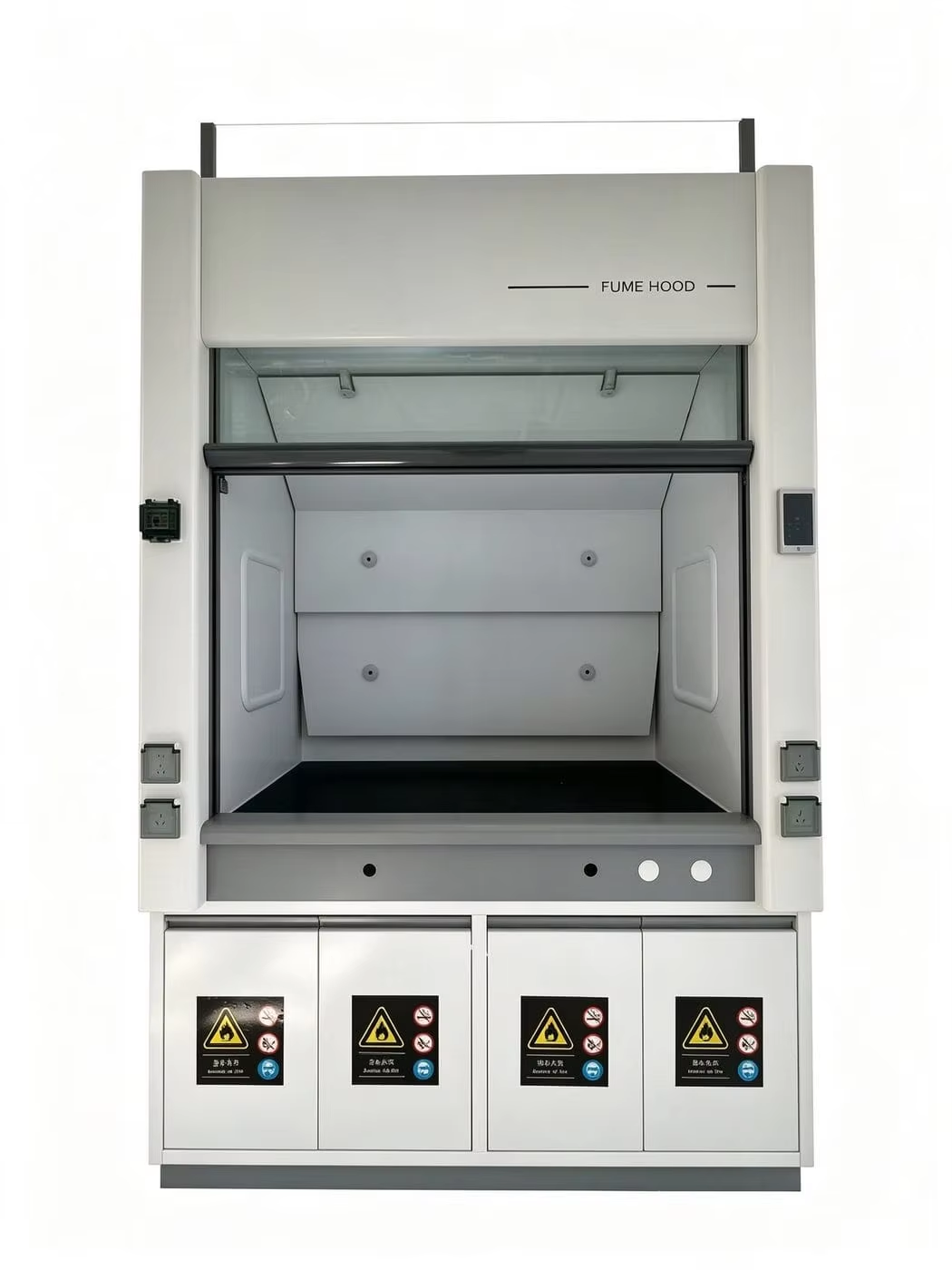
The T6 steel fume hood on the stand, with the control panel set into the side post.
Industrial Safety Cabinet and the Rest of the Storage Line
-
Double-wall steel with an air gap. The cavity slows heat transfer and delays flame penetration, and the door returns itself under spring tension so a fire cannot hold it open. The layout follows NFPA 30 and OSHA flammable storage requirements.
-
A spill sump and flame arresters. A one-piece tray in the base holds the contents of a failed container; both sides carry vents fitted with flame arresters that can be tied into external exhaust.
-
Three-point locking, conductive finish. The rods engage together, the epoxy coating is antistatic and chemical resistant, and shelves adjust for different container heights.
-
A lab safety cabinet for every duty. The range covers flammable liquids, acids and alkalis, gas cylinders and controlled drugs, and the body is offered in phosphated steel or one-piece PP depending on what is stored.
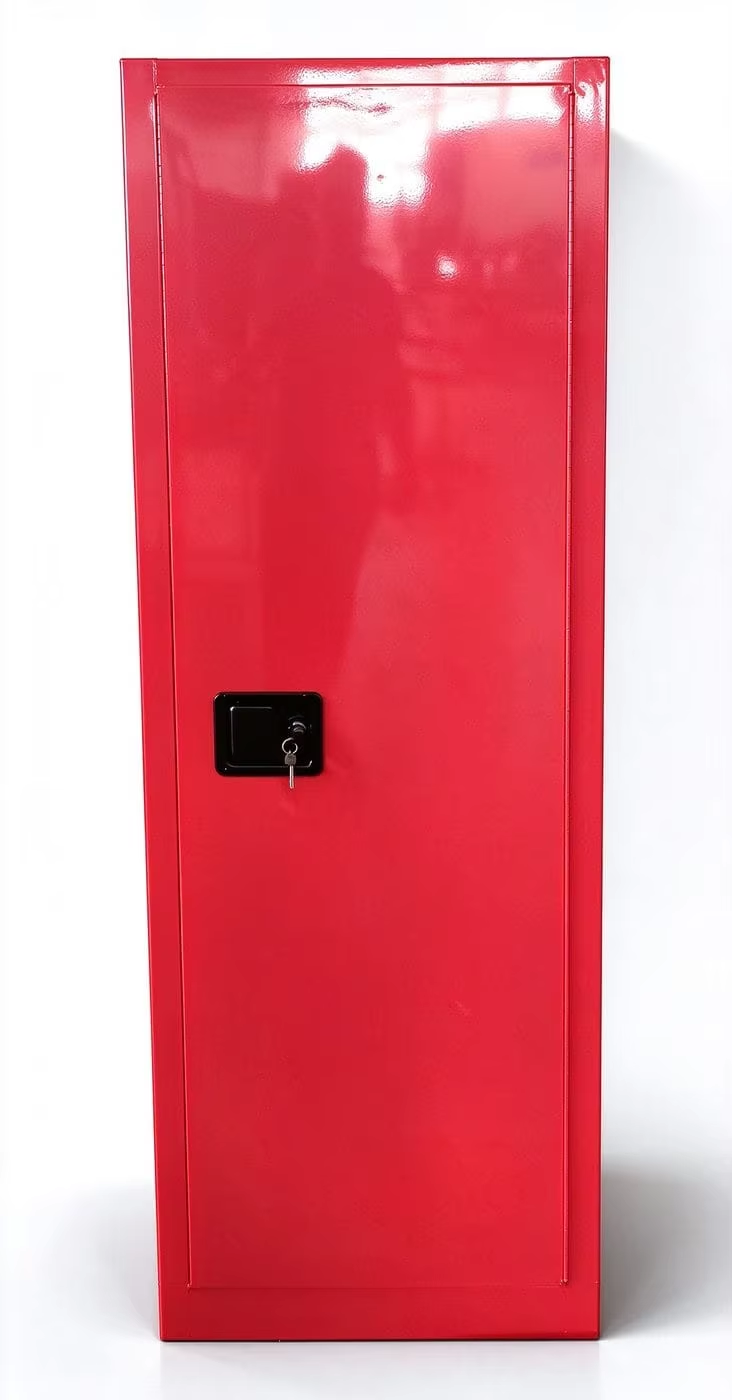
The industrial safety cabinet: double-wall steel body with a self-closing door.
The full range sits under Lab Storage Cabinet.
The F6 All-Steel Lab Bench
The F6 was the model visitors walked around rather than past, because a bench is the part of a laboratory that gets reconfigured first.
-
A solid compact laminate worktop. Resistant to strong acid and alkali, fire retardant, moisture proof, impact resistant and easy to clean, which covers the chemistry a general bench actually sees.
-
An all-steel modular frame. Thicker cold-rolled steel legs and rails with an epoxy coating, designed to carry the load of a working bench, and built so wall cabinets, reagent shelves and sink units can be added, moved or removed without cutting the frame.
-
Services planned in, not drilled later. Water and power positions, sockets and reagent shelf mounts are laid out at the factory, and the bench can be supplied alongside a fume hood or a storage cabinet as one package.
-
Non-standard sizes and OEM supply. The F6 is built to the room, not to a fixed catalog size, which is what makes it workable for a distributor carrying a fume hood, cabinet or lab bench project.
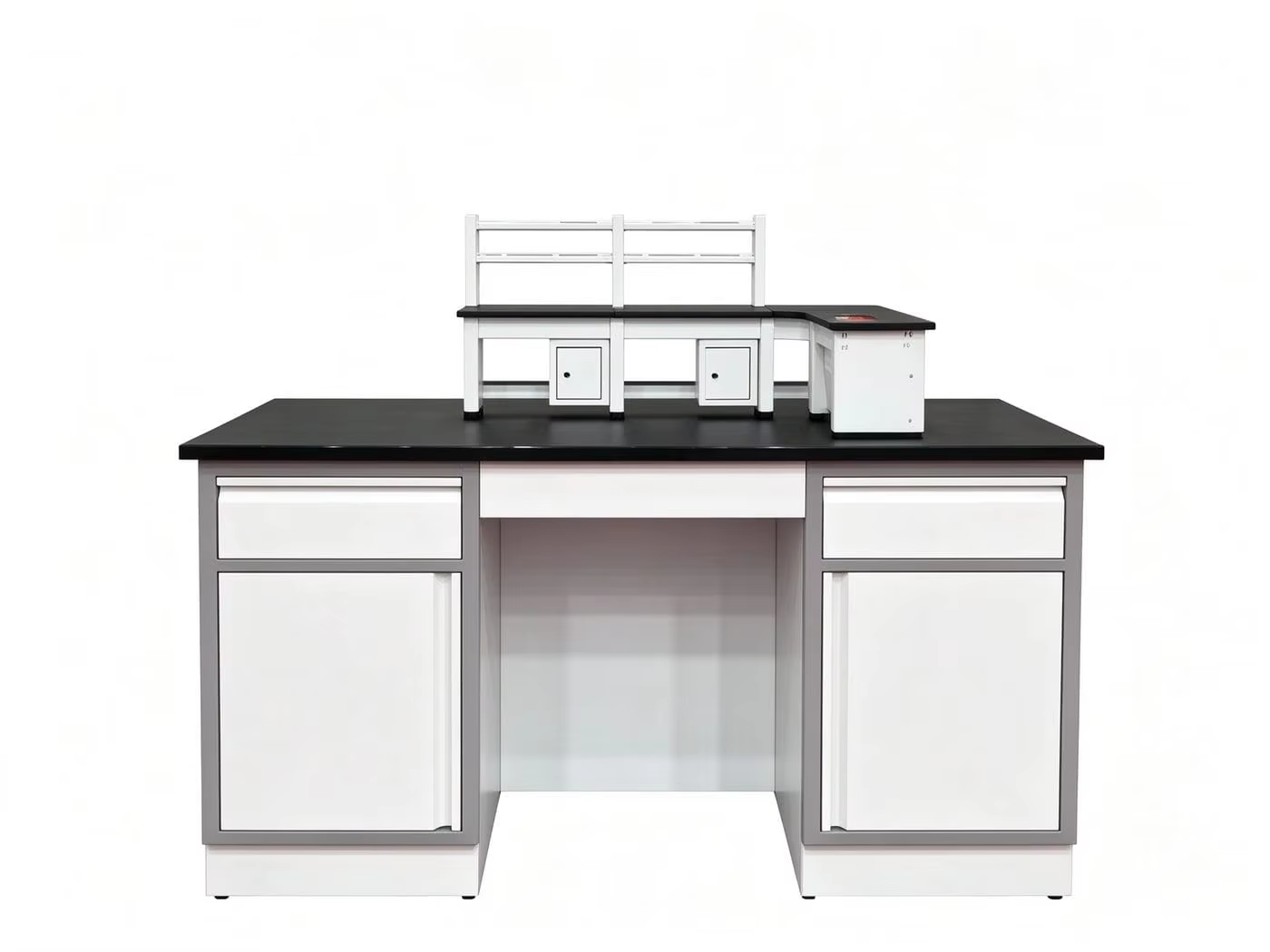
The F6 all-steel lab bench: compact laminate worktop, modular pedestals and a two-tier reagent shelf.
The bench family, including the all-steel lab bench spec sheet, is listed under All Steel Test Bench.
Why Distributors Kept Coming Back
The stand carried a second message this year, printed on the fascia: global distributors wanted, factory direct, OEM and ODM. Bangkok is a distribution city for the region, and a good part of the traffic was not end users but companies that already sell laboratory equipment and want a factory behind them.
What they asked about was predictable and practical: whether the hood and the bench can carry their own brand, whether a mixed container can ship with hoods, cabinets and benches, what the minimum order is, and how a project drawing gets turned around. Those are the questions a laboratory furniture manufacturer has to answer with a factory rather than a price list, and the answers came from one place: five workshops, one drawing office and one export desk.
For a turnkey laboratory, the same setup means the fume hoods, the storage, the all-steel lab bench and the service positions are quoted as one package on one drawing, instead of four suppliers arguing over the interface.
What Buyers Took Away
-
A layout plan. A room-level drawing with bench runs, sink positions and fume hood locations marked, at quotation stage and without charge.
-
Thai standard compliance advice. The documentation questions Thai laboratories raise during approval, discussed before the order rather than after it.
-
A regional case pack. The product catalog and a set of completed Southeast Asia project references.
-
Show terms. A one-time quotation for orders confirmed at the show, with priority production slots for Southeast Asian projects.
-
A distributor route. Territory, OEM supply and project pricing for a fume hood, a lab safety cabinet or an all-steel lab bench are open for discussion with Thai partners.
FAQ
When and where did Ritop exhibit in Thailand?
Thailand Lab 2026, 2 to 4 September, at BITEC in Bangkok, booth 2Q19.
Should I choose the P2 or the T6 fume hood?
Take the PP fume hood when strong acids are in daily use, because there is no coating to fail. Take the T6 steel fume hood for general chemistry, solvents and light acids, where the steel body is the more economical choice. Most laboratories end up with both.
Is the F6 all-steel lab bench available in custom sizes?
Yes. The frame is modular and the bench is built to the room, including non-standard lengths, sink positions and shelf layouts.
Can you supply under our own brand?
Yes. OEM and ODM supply is available, with the drawing office working from your specification or from ours.
Get Your Quote and Layout Drawing
If you visited booth 2Q19 and want the drawing we discussed, send the room dimensions, the chemicals in use and the equipment list, and we will return a configuration, a layout plan and a quotation. Contact our team to start.
Founded in 2012, Jinhua Ritop Steel Cabinet Co., Ltd. is a laboratory furniture manufacturer running five workshops that cover 80,000 square meters, with ISO 9001, ISO 14001 and ISO 45001 certification and more than 45 patents. Annual output is stated at 50,000 lab benches, 30,000 fume hoods and 25,000 storage cabinets.