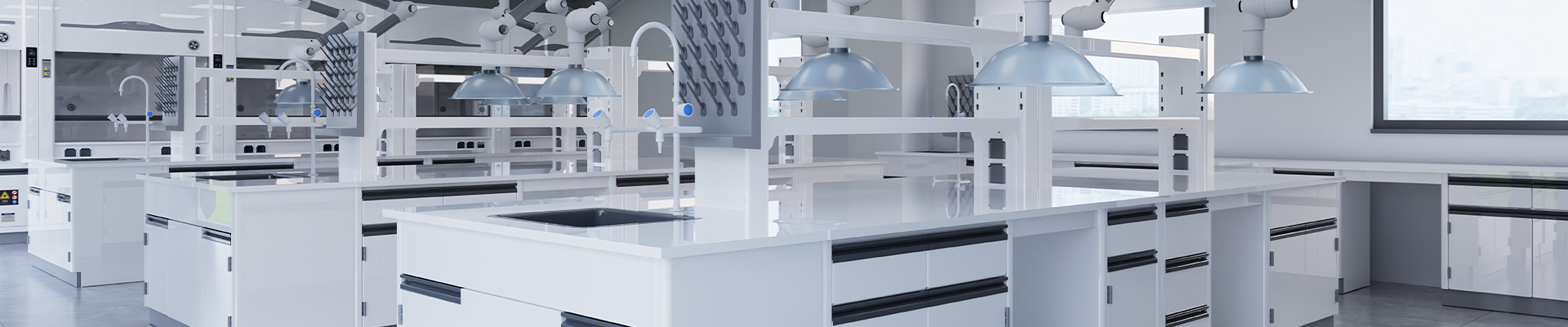
Jinhua Ritop Steel Cabinet Co., Ltd. exhibited at the 2026 Russia laboratory exhibition, from 22 to 24 April, at booth A7073. The stand carried three models: the P2 PP fume hood, an industrial safety cabinet and the F7 lab bench, with the hood running live and the cabinet opened and locked in front of visitors.
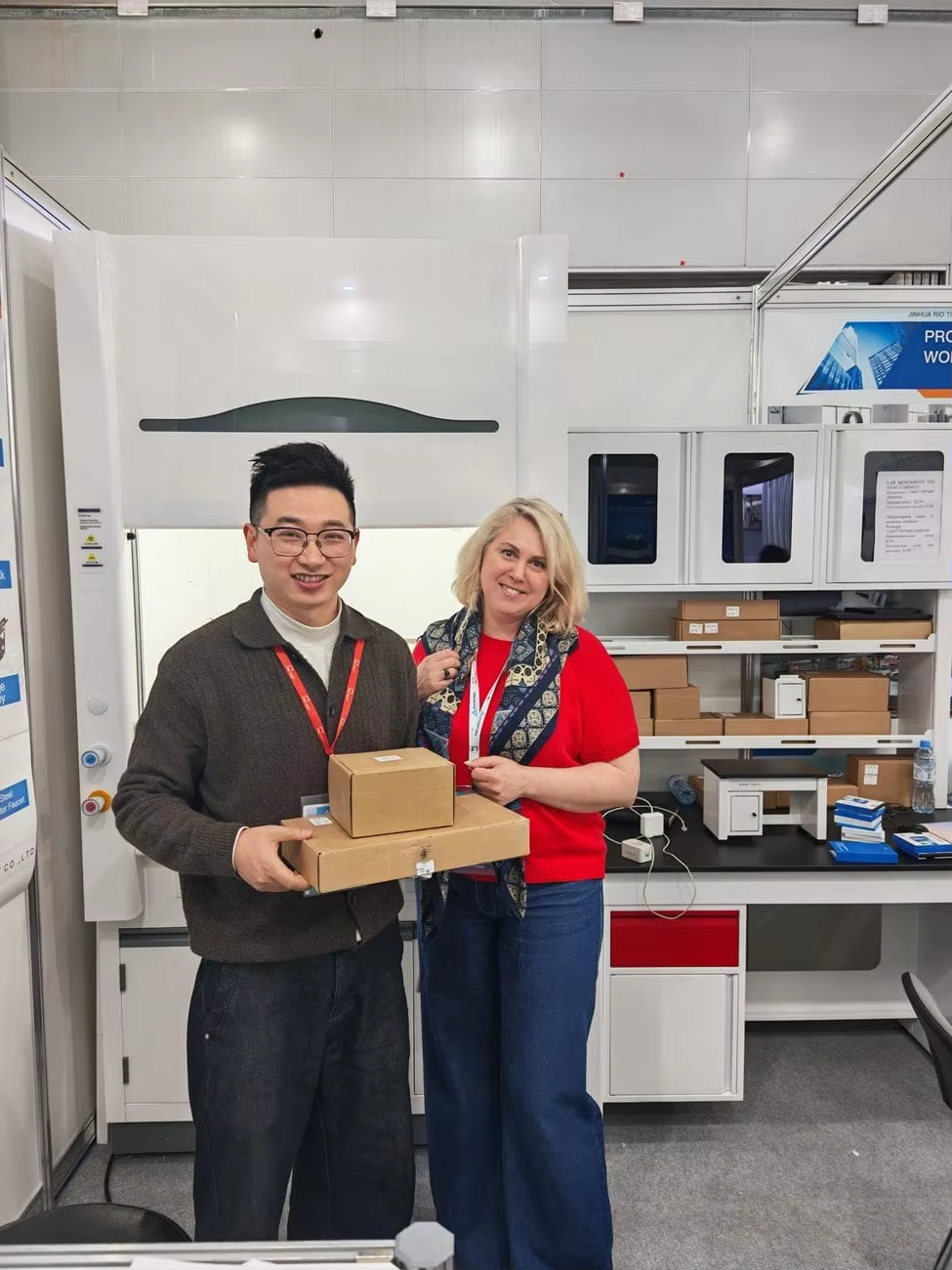
Handing over the English and Russian documentation pack at booth A7073.
What Stood at Booth A7073
| Model |
What it is |
The question it answers |
| P2 |
PP fume hood in 8-10 mm polypropylene |
Strong-acid work that destroys a coated steel chamber |
| Industrial safety cabinet |
Double-wall steel body with a self-closing door |
Flammable liquid storage inside the laboratory |
| F7 |
Lab bench on a C-steel frame with a 12.7 mm solid compact laminate top |
Benches that must be reconfigured after commissioning |
Two things separated this stand from a catalog page. The fume hood ran, so a visitor could watch the airflow at the sash instead of reading a number, and the safety cabinet was opened and closed repeatedly.
The P2 PP Fume Hood: Built for Acid, Controlled by Sensor
-
Face velocity held between 0.3 and 0.5 m/s. A streamlined collection chamber behind the baffle spreads the airflow across the whole opening rather than pulling a fast column up the center, so the working zone stays clear of eddies. The design follows the ASHRAE 110 containment approach, and the airflow is measured at the sash rather than promised on paper.
-
A polypropylene chamber with no seam inside. The working chamber is built from 8 to 10 mm polypropylene sheet, cut on CNC and welded into a single shell. There is no joint for acid to creep behind and no coating to blister, which is the point of a PP fume hood in hydrofluoric, nitric or hydrochloric acid service. The material also resists organic solvents and does not embrittle with age.
-
Control that watches the sash as well as the air. The touch controller tracks airflow and sash height at the same time, alarms when the sash passes its working limit or the airflow drifts, and can be ordered with a variable-air-volume mode that follows sash position. Our own comparison puts that at roughly 30% less energy than a constant-volume fume hood.
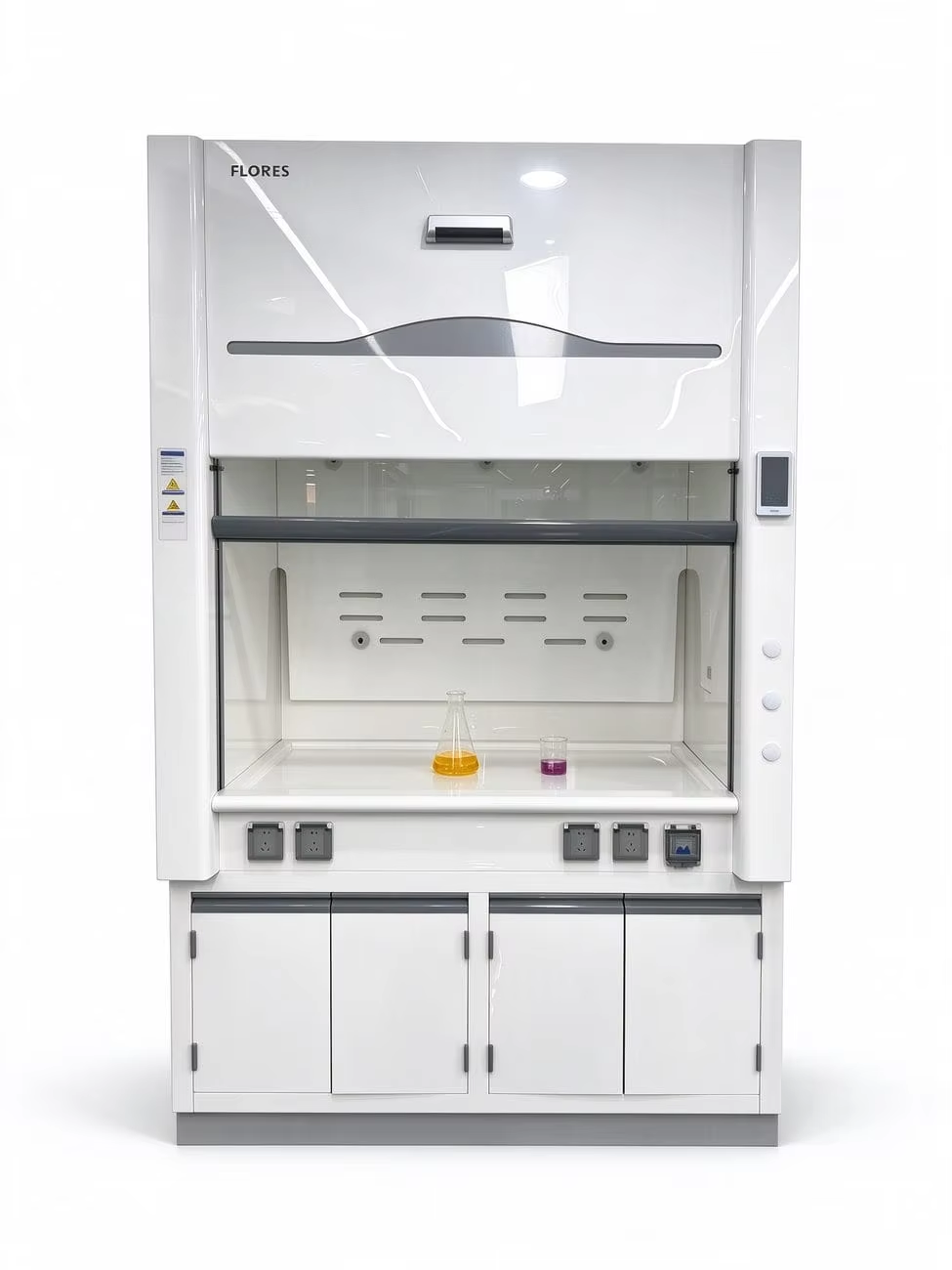
The P2 PP fume hood: an 8-10 mm polypropylene chamber welded into one shell.
The PP models, the steel models and the ductless units are listed together under Lab Fume Hood.
The Industrial Safety Cabinet: Fire, Leak and Access
-
Double-wall steel with an air gap. The cavity between the walls slows heat transfer and delays flame penetration, and the door returns itself under spring tension so a fire cannot leave it standing open. The layout follows NFPA 30 and OSHA flammable storage requirements.
-
An integrated spill sump and flame-arresting vents. A one-piece tray in the base catches the contents of a failed container, and both sides carry vents with flame arresters that can be connected to external exhaust to pull flammable vapor out of the room.
-
Three-point locking and a conductive finish. The rods engage together for a tight seal, the epoxy coating is antistatic and chemical resistant, and the shelves adjust so different container heights fit.
-
A lab safety cabinet for each duty. The same body is built for flammable liquids, acids and alkalis, gas cylinders and controlled drugs, in phosphated steel or one-piece PP depending on what is stored.
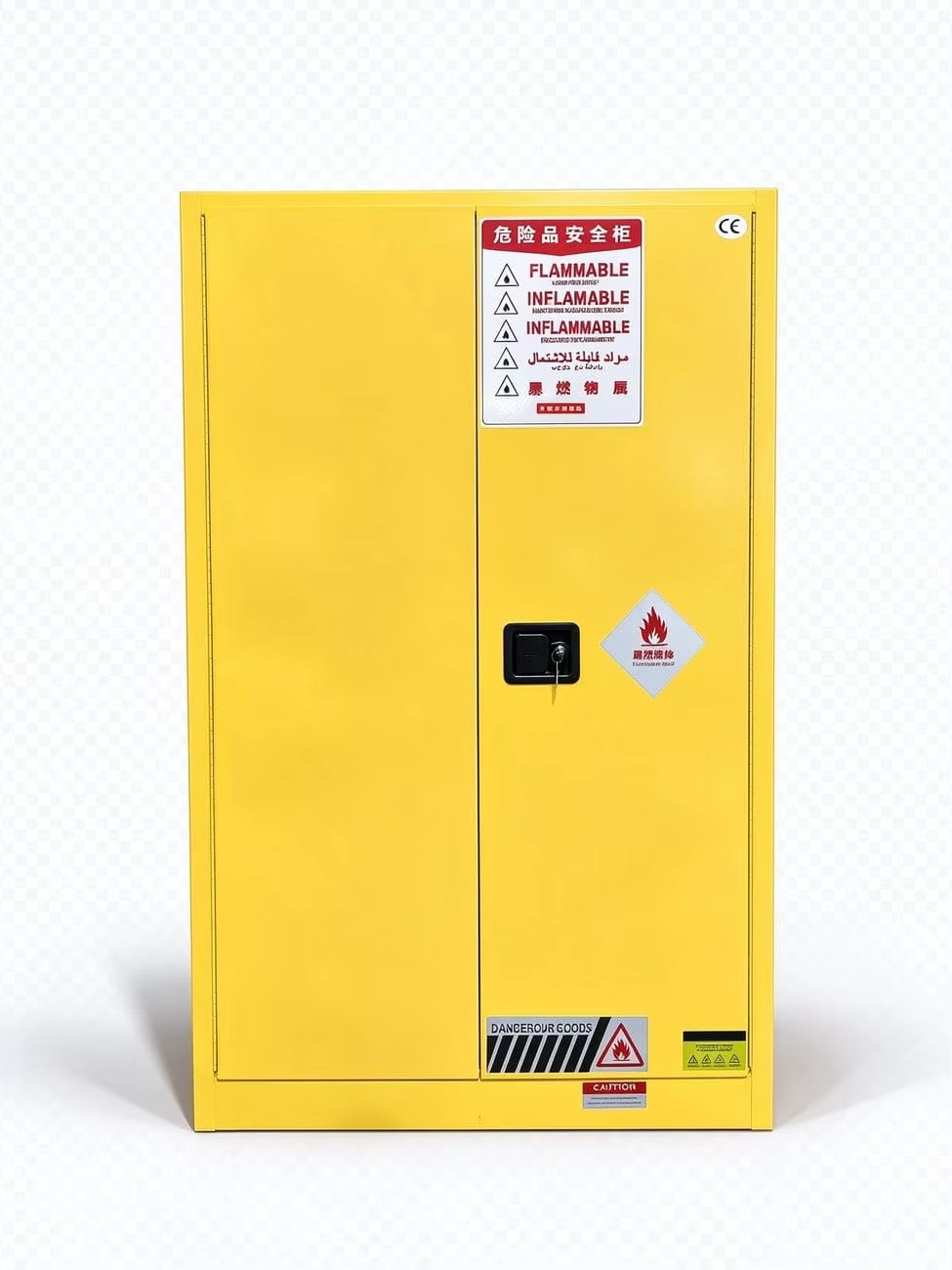
The industrial safety cabinet, with hazard labelling and the key lock on the door.
The range sits under Lab Storage Cabinet, together with the lab safety cabinet models for gas cylinders and controlled drugs.
The F7 Lab Bench: Steel Frame, Solid Top, Modular by Design
-
A 12.7 mm solid compact laminate worktop. One-piece, dense and non-porous, resistant to strong acid, alkali and organic solvents, scratch and heat resistant, and stable in humidity. It is the part of a lab bench that decides how long the bench lasts.
-
A C-steel frame that carries the load. Welded C-section steel is reinforced at the joints, and the modular build lets a project add steel cabinets, PP cabinets, reagent shelves, a sink, a drip rack or an extractor arm without cutting the frame.
-
Cabinets that survive chemistry and use. Cold-rolled steel is pickled and phosphated before the epoxy powder coat, which gives adhesion and rust resistance, and the drawers and doors run on silent slides and hinges with dust protection.
-
Fast on site. Flat-packed modules assemble quickly, which matters when a laboratory is fitted inside a building program that is already running late.
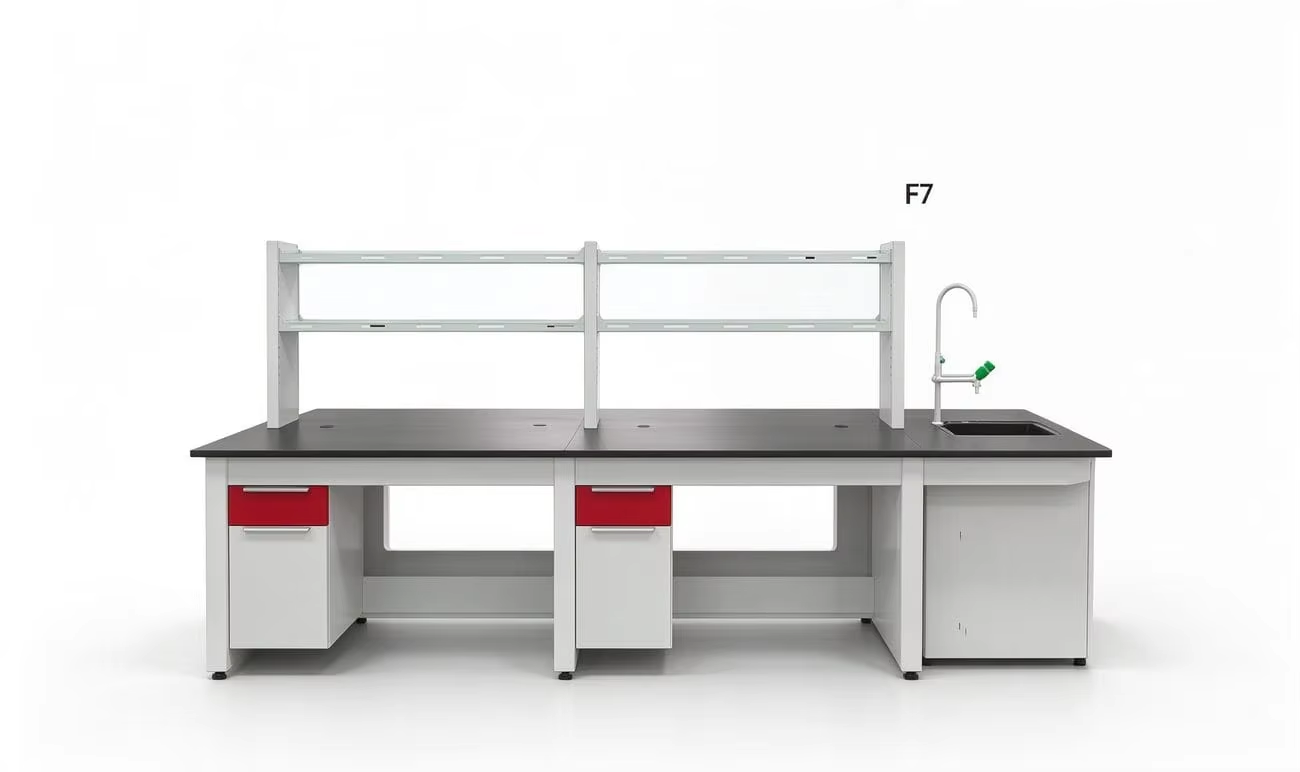
The F7 lab bench: a 12.7 mm solid compact laminate top on a C-steel frame, with a two-tier reagent shelf and a sink unit.
The bench family is listed under All Steel Test Bench.
Why the Documentation Mattered More Than the Discount
Every market has one question that decides a purchase, and for a lab furniture buyer in Russia it is paperwork. A laboratory manager can like a fume hood and still not be able to buy it if the technical file does not match what the certification body and the customs broker expect.
So the offer at booth A7073 was built around the file, not only the product:
-
An English and Russian documentation pack. Specification sheets, CAD drawings and test reports, prepared so a Russian-speaking engineer can check the drawing against the room without waiting for a translation.
-
An EAC documentation package. The technical material a buyer needs to take the equipment through EAC certification with their own certification body, rather than a claim that a certificate already exists.
-
Layout and ventilation planning. A room-level drawing with bench runs, sink positions and hood locations marked, plus advice on the duct and fan side, at quotation stage and without charge.
-
Show terms. A quotation fixed for orders confirmed at the exhibition, with additional allowance on bulk orders.
That combination is what a lab furniture supplier has to bring to a market with its own conformity system.
What Visitors Actually Asked
-
Whether the PP hood can be repaired locally. Yes, because the chamber is welded polypropylene rather than a coated panel; a damaged section can be re-welded instead of re-sprayed.
-
Whether one container can carry hoods, cabinets and benches. Yes. All three are made in the same group, so a mixed container is loaded against one packing list.
-
Whether the drawing can follow a Russian room module. Yes. The bench frame is modular and built to the room rather than to a fixed catalog size.
-
Whether the industrial safety cabinet door closes on its own. It does, under spring tension, and visitors tested it at the stand.
-
Whether OEM supply is possible. Yes, with the drawing office working from either specification.
FAQ
Is your laboratory equipment EAC certified?
We supply the EAC documentation package that supports certification, and we work with the buyer's certification body through the process. We do not represent equipment as certified before a certificate has been issued.
Which fume hood should I choose for strong acids?
The P2 PP fume hood, because the chamber is polypropylene rather than coated steel and there is no coating to fail. For solvents and light acids, a steel fume hood is the more economical choice.
Do you provide Russian-language drawings and manuals?
Yes. Specification sheets, CAD drawings and test reports are provided in English and Russian.
Can the F7 bench be supplied as a full laboratory fit-out?
Yes. The bench, the fume hoods, the storage cabinets and the service positions can be quoted as one package on one drawing.
Get Your Quote and Layout Drawing
If you met us at booth A7073 and want the drawing we discussed, or if you did not attend, the same process applies: send the room dimensions, the chemicals in use and the equipment list, and we will return a configuration, a layout plan and a quotation. Contact our team to start.
Founded in 2012, Jinhua Ritop Steel Cabinet Co., Ltd. runs five workshops covering 80,000 square meters, with ISO 9001, ISO 14001 and ISO 45001 certification and more than 45 patents. Annual output is stated at 50,000 lab benches, 30,000 fume hoods and 25,000 storage cabinets.